 |
Documentation of CSL
|
|
|
Documentation of CSL
|
Arbitrary object that can enter mathematical expressions. More...
#include <comparison.h>
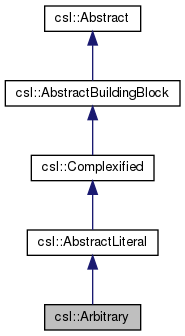
Public Member Functions | |
| Arbitrary (int n, csl::Type t_type=csl::Type::NoType) | |
| Arbitrary (const Arbitrary &other)=default | |
| ~Arbitrary () | |
| Destructor. | |
| std::string const & | getName () const override |
| Returns the Abstract's name. More... | |
| bool | isArbitrary () const override |
| csl::PrimaryType | getPrimaryType () const override |
| Gives the primary type of Abstract. More... | |
| csl::Type | getType () const override |
| Gives the type of Abstract. More... | |
| void | print (int mode=0, std::ostream &out=std::cout, bool lib=false) const override |
| Displays the abstract in standard output. More... | |
| std::string | printLaTeX (int mode=0) const override |
| Creates a LaTeX output for the Abstract. More... | |
| std::optional< Expr > | evaluate (csl::eval::mode user_mode=csl::eval::base) const override |
| Evaluates the Abstract. More... | |
| unique_Expr | copy_unique () const override |
| long long int | getNum () const override |
| bool | operator== (Expr_info expr) const override |
| Compares the Abstract with another. More... | |
| bool | operator< (const Abstract *expr) const override |
 Public Member Functions inherited from csl::AbstractLiteral Public Member Functions inherited from csl::AbstractLiteral | |
| csl::PrimaryType | getPrimaryType () const override |
| Gives the primary type of Abstract. More... | |
| size_t | memoryOverhead () const override |
| std::vector< Parent > | getSubSymbols () const override |
| const std::vector< Equation * > & | getProperties () const override |
| void | addProperty (Equation *property) override |
| Adds a property to the object. More... | |
| void | removeProperty (Equation *property) override |
| Removes a property to the object. More... | |
| Public Member Functions inherited from csl::Complexified | |
| bool | isReal () const override |
| bool | isPurelyImaginary () const override |
| bool | isComplexConjugate () const override |
| std::optional< Expr > | getRealPart () const override |
| Evaluates the real part of the Abstract and returns it. More... | |
| Expr | getImaginaryPart () const override |
| Evaluates the imaginary part of the Abstract and returns it. More... | |
| std::optional< Expr > | getComplexConjugate () const override |
| Calculates and returns the complex conjugate of the expression. More... | |
| void | setConjugated (bool t_conjugated) override |
| void | printProp (std::ostream &fout=std::cout) const override |
| csl::ComplexProperty | getComplexProperty () const override |
| void | setComplexProperty (csl::ComplexProperty prop) override |
| Public Member Functions inherited from csl::AbstractBuildingBlock | |
| bool | isBuildingBlock () const override |
| Tells if the expression is a Building Block or not. More... | |
| virtual bool | commutesWith (Expr_info expr, int sign=-1) const override |
| Tells if the object commutes with expr. More... | |
| std::optional< Expr > | expand (bool full=false, bool inplace=false) const override |
| Develops the Abstract. More... | |
| std::optional< Expr > | factor (bool full=false) const override |
| Factors the Abstract. More... | |
| std::optional< Expr > | factor (Expr_info expr, bool full=false) const override |
| Factors the Abstract wrt a particular Abstract. More... | |
| std::optional< Expr > | getTerm () const override |
| This function returns the same expression as *this but amputated of its numerical factor. Example: (4*cos(x) -> cos(x)). More... | |
| std::optional< Expr > | getComplexModulus () const override |
| Evaluates the modulus in the complex plane of the Abstract and returns it. More... | |
| std::optional< Expr > | getPolynomialTerm (Expr_info expr, int order) const override |
| Calculates and returns the polynomial term corresponding to *this with the variable t_variable at order order. In particular, this function assumes that the checks have already been made with the function isPolynomial(). More... | |
| std::optional< Expr > | findSubExpression (Expr_info subExpression, const Expr &newExpression) const override |
| Searches a sub-expression and replaces it. More... | |
| Public Member Functions inherited from csl::Abstract | |
| Abstract () | |
| Default Constructor. More... | |
| virtual | ~Abstract () |
| Destructor. | |
| Expr | self () |
| virtual void | printCode (int mode=0, std::ostream &out=std::cout) const |
| void | printExplicit (int mode=0) const |
| Displays explicitely the expression, with types of each component. This function is only used for debug. More... | |
| virtual LibDependency | getLibDependency () const |
| virtual std::string const & | getLatexName () const |
| virtual bool | getCommutable () const |
| Allows to know if the object commutes with all the others. More... | |
| virtual bool | getElementary () const |
| virtual bool | getAllDependencies () const |
| virtual int | getDim () const |
| Gives the dimension of the object. More... | |
| virtual int | getOrderOf (Expr_info expr) const |
| virtual bool | isIndexed () const |
| virtual bool | isHermitianConjugate () const |
| virtual bool | isInteger () const |
| Tells if the expression is an integer. Either an Integer object directly, or a Float that has an integer value. More... | |
| virtual bool | getValued () const |
| Tells if the expression is valued, i.e. is a function of numbers and valued literals (a Variable or Constant is not valued by default). More... | |
| virtual long double | getValue () const |
| Returns the value of the expression, if it has one explicitely. In particular, it will work only on Numbers and valued Literals, not on functions. More... | |
| virtual long double | getDeltaPlus () const |
| virtual long double | getDeltaMinus () const |
| virtual long long int | getDenom () const |
| virtual int | getNArgs (int axis=0) const |
| Returns the number of arguments of the expression. If the expression is a building block (AbstractBuildingBlock), this function returns 0. More... | |
| virtual size_t | size () const |
| virtual bool | empty () const |
| virtual csl::vector_expr::iterator | begin () |
| virtual csl::vector_expr::iterator | end () |
| virtual csl::vector_expr::const_iterator | begin () const |
| virtual csl::vector_expr::const_iterator | end () const |
| virtual Expr const & | getArgument (int iArg=0) const |
| virtual Expr & | getArgument (int iArg=0) |
| virtual Expr const & | getArgument (const std::vector< int > &indices) const |
| Allows to get specific arguments of expressions in multiple dimensions, by giving the indices in each dimension. More... | |
| virtual Expr & | getArgument (const std::vector< int > &indices) |
| virtual const csl::vector_expr & | getVectorArgument () const |
| Allows to get the entire std::vector of arguments of the expression. More... | |
| virtual Expr | getVariable () const |
| Accessor to the variable that defines certain types of expressions. More... | |
| virtual int | getOrder () const |
| Accessor to the order (integer) that defines certain types of expressions. More... | |
| virtual int | getSign () const |
| virtual bool | isAnOperator () const |
| Tells if the expression is an operator (like a derivetive operator). More... | |
| virtual bool | isEmpty () const |
| Tells for a Derivative or an Integral if the argument is empty i.e. if the object must apply on the next argument encountered on the right. More... | |
| virtual bool | operatorAppliesOn (Expr_info expr) const |
| virtual Expr | getOperand () const |
| Returns the operand of an Operator. More... | |
| virtual std::vector< int > | getShape () const |
| Accessor to the shape of the tensor in the form of a std::vector of integers. More... | |
| virtual Expr | getInfBoundary () const |
| virtual Expr | getSupBoundary () const |
| virtual void | setSupBoundary (Expr const &t_inf) |
| virtual void | setInfBoundary (Expr const &t_inf) |
| virtual int | getNIndices () const |
| virtual Index | getIndex (int i=0) const |
| virtual void | resetIndexStructure () |
| virtual IndexStructure | getIndexStructure () const |
| IndexStructure | getIndexStructure (csl::Space const *space) const |
| virtual const IndexStructure & | getIndexStructureView () const |
| virtual IndexStructure & | getIndexStructureView () |
| virtual IndexStructure | getFreeIndexStructure () const |
| virtual Parent | getParent () const |
| For indicial expressions this function returns a pointer to the parent object of type TensorParent (not an expression). More... | |
| virtual Parent_info | getParent_info () const |
| virtual Tensor | getPoint () const |
| virtual int | getNContractedPairs () const |
| Returns the number of contracted pairs of indices in an Indicial expression. More... | |
| virtual csl::vector_expr | getPermutations (bool optimize=true) const |
| Returns a std::vector of all possible permutations of an Indicial expression. The possible permutations are determined from the posible symmetries and anti-symmetries of the object. More... | |
| virtual std::set< std::pair< int, int > > | getContractedPair () const |
| Expr | copy () const |
| virtual Expr | deepCopy () const |
| virtual Expr | refresh () const |
| virtual Expr | deepRefresh () const |
| virtual void | setName (const std::string &t_name) |
| Change the name of the abstract. More... | |
| virtual void | setCommutable (bool t_commutable) |
| Allows the abstract to commute or not. More... | |
| virtual void | setValue (long double t_value) |
| Sets the value if there is one (for Numerical and Literal valued). | |
| virtual void | setValue (Expr const &t_value) |
| virtual void | setElementary (bool t_elementary) |
| virtual void | setAllDependencies (bool t_allDependencies) |
| virtual void | addDependency (Expr const &expr) |
| virtual void | removeDependency (Expr const &expr) |
| virtual void | setArgument (const Expr &expr, int iArg=0) |
| Sets the argument at position iArg (default=0). More... | |
| virtual void | setArgument (const Expr &expr, const std::vector< int > &indices) |
| Sets the argument at position {i,j,...} for multi-dimensions expressions. More... | |
| virtual void | setEmpty (bool t_empty) |
| virtual void | setOperand (const Expr &operand) |
| Sets the operand of an operator. More... | |
| virtual void | setOperandPrivate (const Expr &operand, bool leaveEmpty) |
| Sets the operand of an operator. More... | |
| virtual void | setVectorArgument (const csl::vector_expr &t_argument) |
| Replaced the entire std::vector of argument. More... | |
| virtual void | setVariable (Expr const &t_variable) |
| virtual void | insert (const Expr &expr, bool side=1) |
| Inserts an expression in a sum or a product. More... | |
| virtual void | setParent (const Parent &t_parent) |
| virtual std::optional< Expr > | replaceIndex (const Index &indexToReplace, const Index &newIndex, bool refresh=true) const |
| For indicial expressions, this function searches indexToContract and replaces it with newIndex. More... | |
| virtual std::optional< Expr > | replaceIndices (std::vector< Index > const &indexToReplace, std::vector< Index > const &newIndex, bool refresh=true, bool flipped=false) const |
| virtual void | replaceIndexInPlace (Index const &oldIndex, Index const &newIndex) |
| std::optional< Expr > | contractIndex (const Index &index) const |
| csl::vector_expr | breakSpace (const Space *brokenSpace, const std::vector< const Space *> &newSpace) const |
| virtual csl::vector_expr | breakSpace (const Space *brokenSpace, const std::vector< const Space *> &newSpace, const std::vector< std::string > &indexNames) const |
| virtual void | setIndexStructure (const IndexStructure &t_index) |
| Replaces the index structure of the object, that must be an Indicial expression. More... | |
| virtual void | setPoint (const Tensor &t_point) |
| virtual void | setFullySymmetric () |
| Sets an Indicial object fully symmetric. Allows to set quickly a frequent property of tensors. This function then erases all properties of symmetry / antisymmetry and sets fullySymmetric to True. | |
| virtual void | setFullyAntiSymmetric () |
| Sets an Indicial object fully anti-symmetric. Allows to set quickly a frequent property of tensors. This function then erases all properties * of symmetry / antisymmetry and sets fullyAntiSymmetric to True. | |
| virtual void | addSymmetry (int i1, int i2) |
| Add a symmetry between the i1^{th} and the i2^{th} indices. If those indices are anti-symmetric, an error is thrown. More... | |
| virtual void | addAntiSymmetry (int i1, int i2) |
| Add an anti-symmetry between the i1^{th} and the i2^{th} indices. If those indices are symmetric, an error is thrown. More... | |
| virtual int | permut (int i1, int i2) |
| Tries to permut indices at place i1 and i2. If those two indices have a symmetry property, indices are swaped and the symmetry is returned. Else the fnuction does nothing and returns 0. More... | |
| virtual Expr | getNumericalFactor () const |
| Returns the numerical factor of the expression, i.e. returns C if the expression if of the form C*x (x having a numerical factor equal to 1), and return 1 else. More... | |
| virtual int | getNFactor () const |
| virtual csl::vector_expr | getFactors () const |
| Allows to get a std::vector of all terms than could factor the expression. More... | |
| virtual void | getExponents (std::vector< Expr > const &factors, std::vector< Expr > &exponents) const |
| Fills in a vector the exponents corresponding to some factors for the expression. More... | |
| virtual bool | checkIndexStructure (const std::vector< Index > &t_index) const |
| Checks the compatibility of the index structure of an Indicial expression with another. In a sum, two terms must have exaclty the same index structure. More... | |
| virtual bool | checkIndexStructure (const std::initializer_list< Index > &index) const |
| Checks the compatibility of the index structure of an Indicial expression with another. In a sum, two terms must have exaclty the same index structure. More... | |
| virtual bool | compareWithDummy (Expr_info expr, std::map< Index, Index > &constraints, bool keepAllCosntraints=false) const |
| Comparison disregarding name of dummy indices, i.e. the two expressions * are equals even if dummy indices have not the same names in *this and * expr. More... | |
| bool | compareWithDummy (Expr_info expr, bool keepAllCosntraints=false) const |
| virtual int | getParity (Expr_info t_variable) const |
| Returns the parity property of the expression with respect to t_variable. More... | |
| virtual bool | askTerm (Expr_info expr, bool exact=false) const |
| Check if expr can factor *this. More... | |
| virtual bool | dependsOn (Expr_info expr) const |
| Check recursively if the expression depends on expr. More... | |
| virtual bool | dependsOn (Parent_info parent) const |
| virtual bool | dependsExplicitlyOn (Expr_info expr) const |
| Check recursively if expr is present in the expression. More... | |
| virtual bool | dependsExplicitlyOn (Parent_info parent) const |
| virtual int | isPolynomial (Expr_info expr) const |
| Determines if the expression is a mononomial term in expr, i.e. a term of the form C*expr^n with C independent of expr, n integer. More... | |
| virtual bool | matchShape (Expr_info expr, bool exact=false) const |
| In the case of a vectorial-type expression, this function checks if the shape of expr matches itself. More... | |
| virtual bool | hasContractionProperty (Expr_info B) const |
| Tells (for an Indicial type) if there is a special contraction property with B. More... | |
| virtual bool | hasChainContractionProperty () const |
| virtual std::vector< ContractionChain > | getContractionProperties () const |
| virtual Expr | contraction (Expr_info B) const |
| Applies a special contraction of indices. Before calling this function we must check that there is indeed a contraction by calling the function hasContractionProperty(). More... | |
| virtual Expr | contraction (const csl::vector_expr &chain) const |
| virtual long double | evaluateScalar () const |
| Evaluates the value of the Abstract. More... | |
| virtual std::optional< Expr > | derive (Expr_info expr) const |
| Calculates the derivative of the Abstract wrt another. More... | |
| virtual std::optional< Expr > | collect (std::vector< Expr > const &factors, bool full=false) const |
| Collects terms in sum according to some factors given by the user. More... | |
| virtual Expr | suppressTerm (Expr_info expr) const |
| Remove a factor from an expr, that must have been determined before. More... | |
| virtual std::optional< Expr > | suppressExponent (Expr const &factor, Expr const &exponent) const |
| Returns the expression where the factor factor^exponent has been suppressed. More... | |
| virtual std::optional< Expr > | expand_if (std::function< bool(Expr const &)> const &f, bool full=false, bool inPlace=false) const |
| Develops the Abstract. More... | |
| virtual std::optional< Expr > | getComplexArgument () const |
| Evaluates the argument in the complex plane of the Abstract and returns it. More... | |
| virtual Expr & | applySelfStructureOn (Expr &expr) const |
| virtual std::optional< Expr > | getTransposed (const Space *space, bool applyProp=true) const |
| virtual std::optional< Expr > | getTransposed (const std::vector< const Space *> &spaces, bool applyProp=true) const |
| virtual std::optional< Expr > | getHermitianConjugate (const Space *space) const |
| virtual std::optional< Expr > | getHermitianConjugate (const std::vector< const Space *> &spaces) const |
| virtual csl::vector_expr | getAlternateForms () const |
| Calculates and returns all possible alternate forms of the expression in terms of simplifications. For example 1-sin^2(x) is one of the alternate forms of cos^2(x). More... | |
| virtual Expr | applyOperator (const Expr &operand, bool leaveEmpty=false) const |
| Apply the operator on an operand, iif the expression is an operator. More... | |
| virtual Expr | addition_own (const Expr &expr) const |
| Contains implementation of special addition for Numerical- and Vectorial-types. More... | |
| virtual Expr | multiplication_own (const Expr &expr, bool side=1) const |
| Contains implementation of special multiplication for Numerical- and Vectorial-types. More... | |
| virtual Expr | division_own (const Expr &expr) const |
| Contains implementation of special division for Numerical- and Polynomial-types. For polynomial, the euclidean division of two polynomials is implemented. More... | |
| virtual Expr | exponentiation_own (const Expr &expr) const |
| Contains implementation of special exponentiation for Numerical- and Vectorial-types. More... | |
| virtual Expr | getRegularExpression () const |
| Returns a regular expression from the polynomial, that is a sum where the different powers of the variable appear explicitely. More... | |
| virtual Expr | tensordot (const Expr &expr) const |
| Returns the tensordot of two Vectorial expressions. More... | |
| virtual Expr | dot (const Expr &expr) const |
| Returns the dot product of two Vectorial expressions. More... | |
| virtual Expr | getSum () const |
| Calculates and returns the sum of all elements in the Vectorial object. More... | |
| virtual Expr | getProduct () const |
| Calculates and returns the product of all elements in the Vectorial object. More... | |
| virtual Expr | getVectorialModulus () const |
| Returns the Vectorial modulus of the Vectorial object, that is defined here as the squared root of the sum of element squared. Example: {A_{11}^2+A_{12}^2+}. More... | |
| virtual Expr | getSubVectorial (int iExcept) const |
| Allows to pick a part of a Vectorial expression, excluding the iExcept^{th} element. More... | |
| virtual Expr | getSubVectorial (int iExcept, int jExcept) const |
| Allows to pick a part of a Vectorial expression, excluding the [iExcept^{th},jExcept^{th}] element (useful for matrices). More... | |
| virtual Expr | getSubVectorial (const std::vector< int > &exceptions) const |
| Allows to pick a part of a Vectorial expression, excluding the iExcept^{th} element. More... | |
| virtual Expr | getSubVectorial (const std::vector< std::vector< int >> &keepIndices) const |
| virtual Expr | getSubVectorial (std::vector< std::vector< int >>::const_iterator begin, std::vector< std::vector< int >>::const_iterator end) const |
| virtual Expr | determinant () const |
| Returns the determinant of the object if it corresponds to a square matrix (or a scalar), 0 else. More... | |
| virtual Expr | trace () const |
| virtual Expr | trace (int axis1, int axis2) const |
| Calculates the trace over the axis axis1 and axis2 of a tensor. axis1 and axis2 can be the same, in which case the trace just corresponds to the sum over this particular axis. More... | |
| virtual Expr | transpose () const |
| Calculates and returns the transpose of a 2D matrix. More... | |
| virtual Expr | hermitian () const |
| virtual Expr | symmetrise () const |
| Calculates and returns the symmetrization of a 2D matrix. More... | |
| virtual Expr | antisymmetrise () const |
| Calculates and returns the anti-symmetrization of a 2D matrix. More... | |
| virtual Expr | inverseMatrix () const |
| Calculates and returns the inverse of a 2D square matrix. The applied method is: A^{-1} = 1/det(A)*Com(A)^T. More... | |
| virtual Expr | getCanonicalPermutation () const |
| virtual Expr | applyDiracDelta (const Expr &, const Expr &) const |
| virtual void | operator= (double t_value) |
| Equivalent to the setValue() function. More... | |
| virtual bool | operator== (int t_value) const |
| virtual bool | operator== (double t_value) const |
| virtual bool | operator!= (int t_value) const |
| virtual bool | operator!= (double t_value) const |
| int | testDummy (Expr_info expr) const |
| bool | operator== (const Expr_c &expr) const |
| bool | operator== (const Expr &expr) const |
| bool | operator== (const Abstract &other) const |
| bool | operator!= (Expr_info expr) const |
| bool | operator!= (const Expr_c &expr) const |
| Compares the Abstract with another. More... | |
| bool | operator!= (const Expr &expr) const |
| bool | operator!= (const Abstract &other) const |
| virtual Expr const & | operator[] (int iArg) const |
| Access operator for multi-argument expressions, equivalent to the function getArgument(). More... | |
| virtual Expr & | operator[] (int iArg) |
| Access operator for multi-argument expressions, returns a reference so this function is not const. More... | |
| virtual bool | operator< (Expr_info expr) const =0 |
| Compares the simplicity of the expression to another. More... | |
| bool | operator< (const Expr_c &expr) const |
| Compares the simplicity of the expression to another. More... | |
| bool | operator> (Expr_info expr) const |
| Compares the simplicity of the expression to another. More... | |
| bool | operator> (const Expr_c &expr) const |
| bool | operator<= (Expr_info expr) const |
| bool | operator>= (Expr_info expr) const |
| Compares the simplicity of the expression to another. More... | |
| bool | operator<= (const Expr_c &expr) const |
| Compares the simplicity of the expression to another. More... | |
| bool | operator>= (const Expr_c &expr) const |
Additional Inherited Members | |
| Static Public Member Functions inherited from csl::Abstract | |
| static std::string | regularName (std::string const &name) |
| static std::string | regularName (std::string_view name) |
| static std::string | regularLiteral (std::string const &name) |
| static std::string | regularLiteral (std::string_view name) |
| Protected Member Functions inherited from csl::Complexified | |
| void | applyComplexPropertiesOn (const Expr &expr) const |
| void | applyComplexPropertiesOn (unique_Expr &expr) const |
| Protected Attributes inherited from csl::AbstractLiteral | |
| std::vector< Equation * > | props |
| Protected Attributes inherited from csl::Complexified | |
| bool | conjugated = false |
Arbitrary object that can enter mathematical expressions.
When comparing two expressions, we sometimes want to know if a certain expression respects a certain form or not, independently of the exact sub-expressions.
 .
.
Arbitrary objects are indexed by a number that distinguish them. An Arbitrary object will return true when compared to any expression the first time, and then will be associated with thisa expression to the end of the comparison. Ex:
 .
.
 .
.
Where A stands for Arbitrary objects. The first equality is not true because once  is associated to
  it cannot be equal to
  .
.
|
overridevirtual |
Evaluates the Abstract.
Replaces all variables by their value and evaluating. This function must be used instead of evaluateScalar() when treating not only real scalars.* In particular (x=2, y=3) x+iy evaluates to 3+ 3i whereas evaluateScalar() would return 3.
Implements csl::Abstract.
|
overridevirtual |
|
overridevirtual |
Reimplemented from csl::Abstract.
|
overridevirtual |
Gives the primary type of Abstract.
In the program this function is very often called. It allows different functions to know what type of expr they are manipulating (single number, scalar function with one argument, with multiple argumments, a Vector, etc) in order to do special treatments or simplifications.
Implements csl::Abstract.
|
overridevirtual |
Gives the type of Abstract.
In the program this function is very often called. It allows different functions to know what type of expr they are manipulating (cos, product, number, etc) in order to do special treatments or simplifications.
Implements csl::Abstract.
|
overridevirtual |
Compares the Abstract with another.
Here if two Abstracts have the same name, the function will return true even if they are not mathematically equal. So beware not to name different things the same way.
| expr | Abstract to compare. |
Reimplemented from csl::Complexified.
|
overridevirtual |
Displays the abstract in standard output.
| mode | Tells if the Abstract is printed alone (default) or in another expr. |
Implements csl::Abstract.
|
overridevirtual |
Creates a LaTeX output for the Abstract.
| mode | Tells if the Abstract is printed alone (default) or in another expr. |
Reimplemented from csl::Abstract.
 1.8.13